Summer Bites Different: The Hidden Science of Why Seasonal Organic Produce Hits Harder
Photo: Andy Roberts, CC BY 2.0, via Wikimedia Commons
You've probably noticed it without ever putting words to it. A January carrot from the grocery store tastes like crunchy water. A July carrot pulled from a farmers market bin tastes like a carrot should—earthy, sweet, with that little bitter edge that makes it interesting. Same vegetable. Completely different experience.
This isn't your imagination, and it's not just freshness. The gap between summer and winter produce quality runs much deeper than the calendar. It lives in the soil, in the light, and in the billions of microorganisms that do their best work when conditions are just right.
What the Soil Is Actually Doing in Summer
Here's something that doesn't come up much in conversations about organic food: soil isn't just a growing medium. It's a living system, and like most living systems, it responds dramatically to temperature.
When soil warms up—typically somewhere between 60°F and 85°F depending on the crop and the region—microbial activity explodes. Bacteria, fungi, and other soil organisms that were essentially dormant through winter start breaking down organic matter at a much faster rate. That decomposition releases nutrients in forms that plant roots can actually absorb. Nitrogen, phosphorus, potassium, trace minerals—they all become more bioavailable when the underground ecosystem is firing on all cylinders.
For organic farms especially, this matters enormously. Conventional agriculture can compensate for sluggish soil biology by dumping synthetic fertilizers directly into the root zone. Organic operations don't have that shortcut. They're dependent on a functioning soil food web, which means they're inherently more sensitive to seasonal shifts in microbial activity. When summer hits and that web comes alive, the plants respond. When it doesn't, the harvest reflects the deficit.
Daylight Is a Flavor Ingredient
Longer days don't just mean more growing time—they mean more photosynthesis, and more photosynthesis means more sugars. This is the part that directly hits your taste buds.
Plants convert sunlight into glucose. That glucose gets used for energy, but it also accumulates in fruits and vegetables as natural sweetness. It feeds the aromatic compounds that give a ripe peach its perfume or a summer basil leaf its punch. It drives the production of antioxidants and polyphenols—the same compounds that make organic produce nutritionally interesting in the first place.
A tomato grown in June with 14-plus hours of daylight is metabolically different from the same variety grown in a heated greenhouse in February with supplemental lighting. The light quality matters, too. Ultraviolet exposure triggers stress responses in plants that actually increase their production of protective compounds—compounds that happen to taste complex and interesting to us. That's not a coincidence. We evolved alongside these plants and developed a preference for the flavors that signal nutritional density.
What Regenerative Farmers Are Working With
Farmers who've been doing this for a while don't just accept seasonal variation as a given—they work with it strategically.
Take the approach common among regenerative growers in the mid-Atlantic and Pacific Northwest: planting schedules are designed around soil temperature curves, not just frost dates. The goal is to time transplanting so that the crop's peak nutrient demand lines up with peak microbial activity. Get that timing right, and the plant has access to exactly what it needs when it needs it most. The result shows up on your plate.
Cover cropping plays into this too. Many organic farmers will plant a winter cover—rye, clover, vetch—not primarily to prevent erosion, but to feed soil biology through the cold months. When spring comes and those cover crops get turned in, they provide a burst of organic matter that jumpstarts the microbial community. It's essentially pre-loading the soil for summer performance.
Some growers go further, using compost teas and inoculants to introduce specific microbial strains before the season ramps up. The science on targeted inoculation is still evolving, but the underlying principle—that a more diverse, active soil community produces more flavorful crops—is increasingly well-supported.
The Trade-Off Nobody Talks About
Here's where it gets complicated. Not every organic operation is optimizing for flavor.
Shelf stability and taste are often in direct tension with each other. A tomato bred for long-distance shipping has been selected for thick skin, slow ripening, and resistance to bruising. Those traits are genuinely useful if your supply chain runs from California to a distribution center in Ohio and then to a store shelf and then to someone's kitchen counter over the course of two weeks. But those same traits often come at the cost of sugar content, aromatic volatility, and the textural qualities that make a tomato worth eating.
Organic certification doesn't protect you from this trade-off. A certified organic tomato can still be a variety selected entirely for logistics rather than taste. The organic label tells you something about how it was grown. It says nothing about why that particular variety was chosen, or whether the farm's priorities align with your sensory experience.
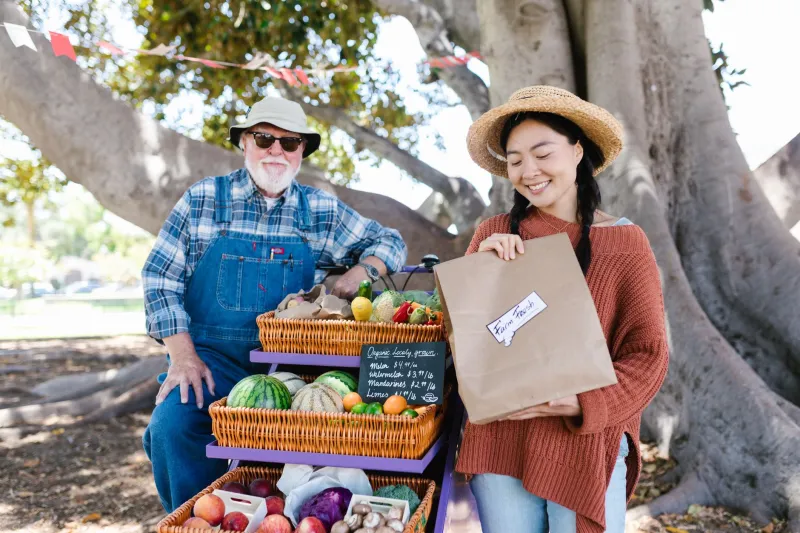
Smaller farms that sell direct—at farmers markets, through CSA subscriptions, or through regional food hubs—are more likely to be making variety choices based on flavor because their customers can actually tell them when something tastes bad. That feedback loop doesn't exist in conventional retail. Nobody's emailing a grocery chain to say their January tomatoes were disappointing.
Eating With the Season Is Actually a Flavor Strategy
All of this points toward something practical. If you want organic produce that tastes like it was worth the price, the single most effective thing you can do is eat closer to the season and closer to the source.
That means leaning into summer abundance—tomatoes, corn, peppers, zucchini, stone fruit—when the soil biology and the daylight are doing their best work together. It means accepting that a February tomato is structurally a different product than an August tomato, no matter what the label says. And it means building relationships with growers who can tell you which varieties they chose and why, because those conversations reveal a lot about what a farm actually values.
The flavor underground is real. It's soil microbes and UV exposure and sugar metabolism and a thousand small decisions farmers make before a seed ever goes in the ground. Summer doesn't taste better by accident. It tastes better because everything the plant needs lines up at once—and the farmers who understand that are the ones growing food that reminds you why you started buying organic in the first place.