What Lives Beneath: The Fungal Underground That's Quietly Transforming Organic Farming
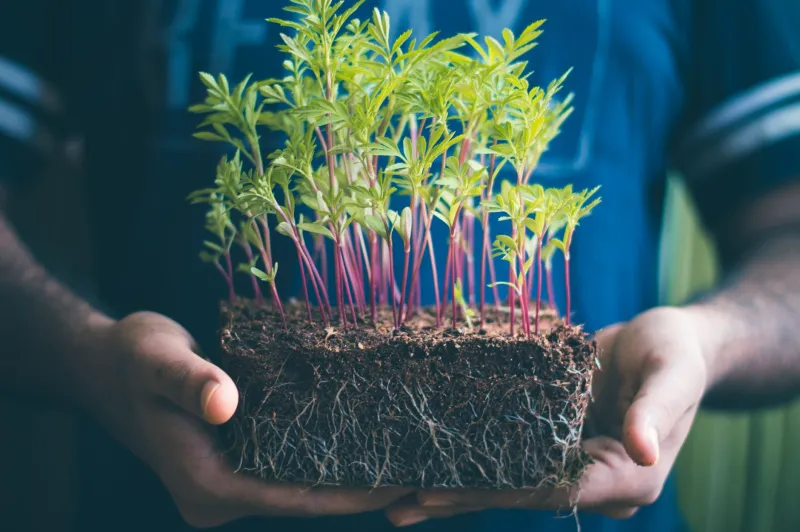
If you've ever pulled a carrot from genuinely healthy soil, you might have noticed something strange clinging to its roots — a faint, almost cobwebby fuzz that doesn't quite look like dirt. Most people brush it off. Forward-thinking farmers are starting to treat it like gold.
That fuzz is mycelium, the thread-like body of mycorrhizal fungi. And what it represents isn't just interesting biology — it's a fundamental rethinking of what soil actually is, and what organic farming could become.
A Partnership Older Than Trees
Mycorrhizal fungi aren't new. They've been forming symbiotic relationships with plant roots since before flowering plants existed — roughly 400 million years ago, give or take a few epochs. The arrangement is elegantly simple: the fungus colonizes a plant's root system, dramatically extending its reach through the soil with a web of microscopic threads called hyphae. The plant gets access to water and nutrients — especially phosphorus, which is notoriously difficult for roots to absorb on their own. In exchange, the plant feeds the fungus sugars produced through photosynthesis.
It's a trade deal that predates agriculture by about 399.9 million years.
The catch? Modern farming has spent the better part of a century accidentally destroying it. Synthetic fertilizers flood soil with the exact nutrients mycorrhizal fungi help plants find, making the relationship redundant. Tillage shreds the delicate hyphal networks. Fungicides — even some approved for organic use — can suppress fungal populations. The result is soil that technically contains all the right inputs but has lost the biological infrastructure to use them well.
Even many certified organic operations, focused on swapping out synthetic inputs for organic ones, haven't fully grappled with this underground reality.
The Farms Paying Attention
But some have. And what they're discovering is changing how they think about fertility, resilience, and the very definition of a healthy crop.
Ridgeline Roots Farm in Sonoma County, California made the shift about six years ago, after owner Delia Marchetti noticed her cover crop rotations weren't delivering the soil improvement she expected. "We were doing everything right on paper," she says. "Compost, minimal tillage, diverse rotations. But the soil still felt tired."
A soil biology consultant introduced her to mycorrhizal inoculants — concentrated preparations of beneficial fungal spores that can be applied to seeds or transplants. Within two seasons, Marchetti noticed her tomatoes were showing better drought tolerance, and she was applying about 30 percent less phosphorus amendment than before. "The fungi are doing the work," she says. "We're just not getting in their way anymore."
Over in the Willamette Valley in Oregon, Thornwood Organic Farm has taken a more systemic approach. Owner Ben Calhoun stopped using even OMRI-listed fungicides after realizing they were suppressing the mycorrhizal populations he was trying to build. Instead, he leaned into companion planting strategies that research suggests support fungal diversity — interplanting crops with deep-rooted species like chicory and daikon radish that create pathways for hyphal networks to spread.
"The conventional organic playbook is still really input-focused," Calhoun says. "You're just substituting organic inputs for synthetic ones. What we're trying to do is reduce the need for inputs altogether by building something that works on its own."
In Vermont, Cedar Ledge Farm has been integrating mycorrhizal science into its CSA operation for nearly a decade. Co-owner Priya Sutherland has started testing the nutrient density of her produce using a refractometer — a tool that measures the concentration of dissolved solids in plant juice, often used as a rough proxy for mineral content. Her readings, she says, have climbed steadily since she began protecting and cultivating fungal networks. "I can't claim a clinical trial," she laughs. "But I'm growing the same varieties in the same fields, and something has changed."
Why Most Organic Farms Still Miss This
So why isn't everyone doing this? The honest answer is a mix of habit, economics, and a certification system that wasn't designed with soil biology in mind.
Organic certification, for all its value, is largely a rules-based framework. It defines what you can and can't use. It doesn't — and arguably can't — certify the health of your soil's living ecosystem. A farm can be 100 percent certified organic and still have microbially depleted soil if it relies heavily on tillage and bagged inputs.
There's also a knowledge gap. Mycorrhizal science is relatively recent in its practical applications, and most agricultural extension programs, even progressive ones, haven't fully integrated it into their recommendations. Farmers learn from other farmers, from consultants, and from trial and error. The information is out there, but it's not yet mainstream.
And then there's the short-term economics problem. Building fungal networks takes time — sometimes several seasons before the benefits become measurable. For farmers operating on thin margins, investing in practices that pay off in year three or four is a hard sell.
What the Science Is Actually Saying
The research base for mycorrhizal applications in agriculture has grown substantially in the last decade. Studies have shown that mycorrhizal inoculation can improve phosphorus uptake, reduce irrigation requirements, and in some cases increase the concentration of certain micronutrients in harvested crops. A 2019 meta-analysis published in the journal New Phytologist found that mycorrhizal fungi increased plant biomass across a wide range of crops and soil conditions.
There are important caveats. Inoculants work best in soils that don't already have thriving native mycorrhizal populations — which means the first step is often figuring out what you've already got. And not all commercial inoculant products are created equal; quality varies widely, and some products on the market have been found to contain far fewer viable spores than advertised.
The more durable lesson, most researchers agree, is less about buying the right product and more about stopping the practices that destroy fungal networks in the first place. Reduce tillage. Limit bare soil. Keep roots in the ground as much as possible. Let the biology do what it's been doing for hundreds of millions of years.
A Different Kind of Fertility
There's something almost philosophical about the mycorrhizal approach to farming. It asks growers to think of the soil not as a medium to be managed but as a community to be cultivated — one with its own intelligence, its own economies, its own version of mutual aid.
For farms like Ridgeline Roots, Thornwood, and Cedar Ledge, that shift in thinking has been as important as any specific technique. The question stops being "what do I need to add?" and starts being "what do I need to stop disrupting?"
Organic farming at its best has always been about working with natural systems rather than against them. The mycorrhizal revolution is just the newest — and in some ways the oldest — expression of that idea. The network was always there. We just had to learn to leave it alone.